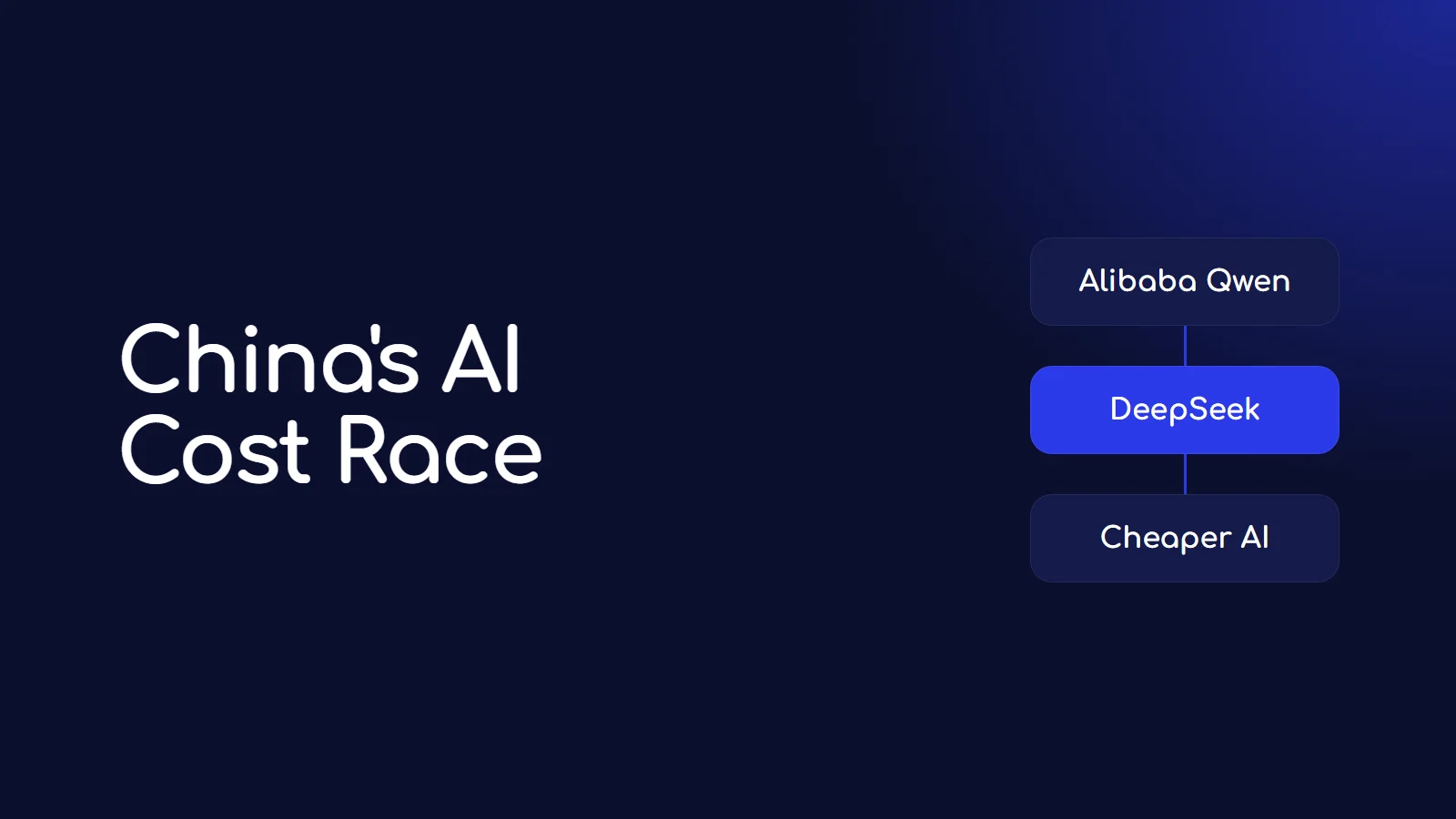
China's artificial intelligence market is entering a phase in which the price of producing a useful answer matters almost as much as the answer itself. A recent AI News report describes Alibaba's Qwen3.8-Max and DeepSeek's V4-Flash as examples of a model race increasingly shaped by inference cost, not only benchmark leadership. That distinction matters for companies moving from pilots to production. A model can look impressive in a demonstration and still be uneconomic when every customer request consumes long context, tool calls, retries, and post-processing.
The competitive question is changing. Instead of asking which laboratory has the largest model, buyers are asking which service can deliver an acceptable result at a stable cost, with sufficient throughput and a deployment path that fits data and compliance requirements. Alibaba brings a broad cloud platform and a large Qwen family to that contest. DeepSeek brings an API designed around OpenAI-compatible access and an emphasis on efficient reasoning workflows. The result is pressure on the market to treat tokens, latency, caching, routing, and hardware utilisation as product features.
Why the cost race is more than a price cut
Inference economics are not captured by one number on a pricing page. The bill depends on input tokens, output tokens, cached context, model selection, request volume, and the infrastructure or service tier. A lower advertised rate can be offset by verbose outputs, repeated system prompts, or an application that sends an entire conversation on every turn. A more capable model may even be cheaper for a task if it completes the job in one call rather than requiring several corrective calls.
There is also a distinction between API price and total cost of ownership. A managed endpoint may carry a higher per-token charge but reduce the engineering work required for scaling, monitoring, regional availability, and upgrades. A self-hosted or dedicated deployment can provide more control, yet transfers the burden of GPU capacity planning, model serving, batching, quantisation, and incident response to the buyer. The correct comparison is the cost of a reliable completed task, not the cost of an isolated token.
Alibaba's Qwen strategy: a family, a platform, and a routing problem
Alibaba Cloud's Model Studio documentation presents Qwen alongside third-party models for text, image, audio, and video use cases. That breadth is strategically important. A team can start with a general model, add a specialised model for a narrow workflow, and keep access behind a common platform layer. The same platform orientation makes routing a central design decision. A request that needs complex reasoning should not automatically consume the most expensive model available.
For a production team, Qwen's value is not only one flagship release. It is the ability to combine model selection with cloud controls, regional operations, credentials, observability, and application services. The tradeoff is that documentation, model names, availability, and pricing can change as the catalogue evolves. Teams should treat model identifiers and rate cards as configuration data, not constants embedded throughout an application.
Example: keep model choice and budgets configurable
import os
from openai import OpenAI

client = OpenAI(
    api_key=os.environ["DASHSCOPE_API_KEY"],
    base_url=os.environ["DASHSCOPE_BASE_URL"]
)
model = os.getenv("QWEN_MODEL", "qwen-plus")
max_tokens = int(os.getenv("MAX_OUTPUT_TOKENS", "700"))
response = client.chat.completions.create(
    model=model,
    messages=[
        {"role":"system","content":"Answer concisely using supplied context."},
        {"role":"user","content":"Summarise the customer request."}
    ], max_tokens=max_tokens, temperature=0.2
)
print(response.choices[0].message.content)
This pattern makes the model, endpoint, and output ceiling replaceable through deployment configuration. That is safer when a provider retires an identifier, adds a regional endpoint, or changes the economics of a model tier. The application should record the model identifier and usage returned by the API so cost analysis stays tied to the actual call.
DeepSeek's API approach: compatibility lowers switching friction
DeepSeek's documentation states that its API is compatible with OpenAI and Anthropic formats. Its quick-start page documents the OpenAI base URL as https://api.deepseek.com and lists model identifiers including deepseek-v4-flash and deepseek-v4-pro. The page says the Flash identifier can resolve to an updated dated version while preserving the calling method. For developers, compatibility reduces the code required to compare providers or maintain a fallback path.
Compatibility does not eliminate operational differences. Reasoning controls, context limits, rate limits, billing rules, retention policies, and regional routing still need review. An application that changes only the base URL may compile and return text while silently changing latency, output length, or reasoning behaviour. A provider abstraction should expose capabilities that affect cost and quality rather than pretending every model is interchangeable.
Example: make reasoning an explicit policy
import os
from openai import OpenAI
client = OpenAI(
    api_key=os.environ["DEEPSEEK_API_KEY"],
    base_url="https://api.deepseek.com"
)
result = client.chat.completions.create(
    model=os.getenv("DEEPSEEK_MODEL", "deepseek-v4-flash"),
    messages=[
        {"role":"system","content":"Return a short structured answer."},
        {"role":"user","content":"Classify this support ticket and explain why."}
    ], thinking={"type":"enabled"}, reasoning_effort="medium", stream=False
)
print(result.choices[0].message.content)
The lesson is not that reasoning should always be enabled or disabled. The choice must be visible in the request and measured against the task. A reasoning-heavy response may improve difficult classifications but waste budget on routine extraction. Define task classes, assign a model and reasoning policy to each, then review quality and cost together.
What actually lowers inference cost
Route by task difficulty
Use a small or fast model for extraction, classification, rewriting, and simple retrieval-grounded answers. Escalate ambiguous cases to a stronger model. A router can use confidence thresholds, business rules, or a lightweight first pass. The goal is not to force every request through the cheapest endpoint. It is to reserve expensive computation for cases where it changes the outcome.
Control context and output
Long prompts are often an application design problem. Remove duplicate instructions, summarise stale conversation turns, retrieve only relevant passages, and cap output where the user does not need an essay. Output limits improve latency and reduce unusable verbosity. Any truncation policy should be checked against task acceptance criteria.
Cache stable work
System prompts, policy text, product catalogues, and repeated documents can be candidates for provider-supported context caching or an application cache. Caching is not free in every implementation, and stale data can create correctness failures. Define invalidation rules, include a version identifier in the cache key, and measure cache hit rate separately from total request volume.
Batch asynchronous jobs
Nightly enrichment, document tagging, and report generation rarely need interactive latency. Queuing these jobs allows batching and more predictable capacity planning. Persist an idempotency key, retry only transient failures, and expose a dead-letter path for requests that repeatedly fail validation.
Measure cost per completed task
Token cost is an input metric. The business metric is often cost per accepted classification, resolved ticket, generated report, or successful workflow. Track prompt tokens, completion tokens, cache status, latency, retries, model, region, and human correction rate. This reveals when a cheaper model creates hidden labour costs or when a larger model reduces total calls.
Troubleshooting common failures
Authentication and endpoint errors
Confirm that the key is present in the process environment and that the base URL matches current provider documentation. Never place keys in source control or client-side code. A 401 usually indicates a missing, malformed, expired, or incorrectly scoped credential. A 404 can indicate a wrong path, unsupported model identifier, or endpoint mismatch.
Model name or availability errors
Model catalogues change. Read the current model list and record the exact identifier in deployment configuration. Avoid silently substituting a different model after an error. If a fallback is necessary, log the fallback event and apply a separate budget and quality policy.
Unexpectedly high bills
Inspect input and output token distributions rather than request counts alone. Common causes include duplicated history, runaway tool loops, retries that repeat successful work, and prompts that request reasoning for a short label. Add per-request ceilings, alert on percentile usage, and test long-context cases before launch.
Slow or unstable responses
Separate provider latency from application latency. Record connection time, time to first token, total generation time, queue time, and downstream processing. Streaming can improve perceived responsiveness, but does not necessarily reduce total token cost. Retries should use bounded exponential backoff and should not repeat non-idempotent side effects.
Limits of the cost narrative
Cheaper inference does not automatically mean better AI. Prices can move, exchange rates and taxes can affect invoices, and service availability can differ by region. Public model descriptions do not provide a complete basis for comparing quality on a particular company's data. Benchmarks do not replace evaluation built around acceptance criteria, privacy constraints, and failure costs.
Open or accessible model weights, when available, introduce another set of costs. Hardware depreciation, power, networking, storage, engineering time, security updates, and spare capacity all matter. A hosted API and self-managed deployment should be compared over the same period and workload shape. The lowest unit price can be the wrong choice if it creates operational risk or an unreviewed dependency.
FAQ
Is the China AI race only about lower prices?
No. Cost is one competitive axis alongside capability, latency, reliability, ecosystem, safety controls, and access to infrastructure. Lower inference cost matters because it changes which applications can be deployed at scale.
Should a team choose Alibaba or DeepSeek?
There is no universal winner. Compare models on representative tasks, then include region, data handling, rate limits, integration support, and total cost per accepted task. Keep the provider interface configurable so the decision can be revisited.
Does OpenAI compatibility guarantee a drop-in migration?
No. It can reduce code changes, but parameters, capabilities, error formats, limits, pricing, and reasoning controls still need validation. Run contract tests and log provider-specific behaviour.
What is the first cost optimisation to implement?
Start with measurement. Capture tokens, model, latency, retries, cache status, and outcome quality. Then remove duplicated context and set output ceilings before attempting complex routing.
Are published prices enough for a budget?
They are a starting point, not a forecast. Add expected traffic, token distributions, retries, caching assumptions, taxes or currency effects, support tiers, and engineering overhead. Recalculate when a provider changes its catalogue or pricing.
Conclusion
Alibaba and DeepSeek are helping shift China's AI competition toward the economics of useful computation. The important contest is not simply who can announce the largest model. It is who can provide dependable capability at a cost that supports real products, while giving developers control over routing, context, reasoning, and deployment.
For buyers, the durable response is disciplined rather than promotional. Treat model names and prices as changing inputs, instrument every request, evaluate completed tasks, and keep a tested fallback path. Organisations that benefit most from lower inference costs will be those that turn cheap tokens into efficient workflows, not those that merely choose the lowest number on a rate card.