The boundary between an AI application and its infrastructure is moving. Developers increasingly need more than a single model endpoint. They need a way to compare models, select providers, handle outages, control spend, observe usage, and connect all of that to a product's payment flow.
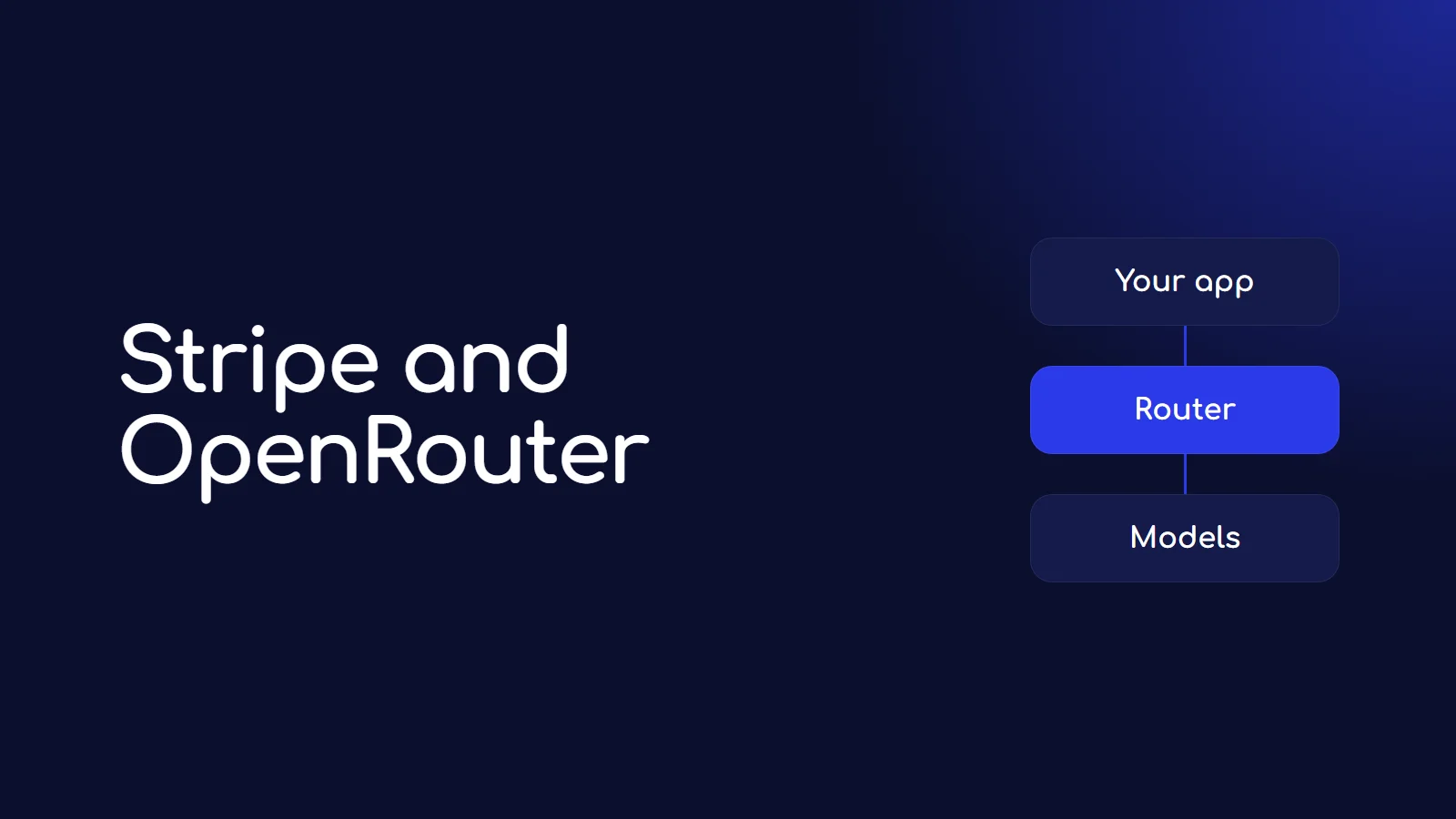
That is why the reported Stripe acquisition of OpenRouter matters. The news is not simply about one payments company adding one AI company to its portfolio. It points to a broader product direction: AI applications may be built around a routing and economic layer that sits between application code and model providers. OpenRouter's documentation describes a unified API for accessing models and provider routing features, while Stripe provides APIs and hosted components for accepting payments. Together, those capabilities suggest a developer stack in which model access and monetization can be designed as related parts of the same system.
This article separates what the public report says from the practical engineering lessons developers can apply today. It does not assume that the acquisition changes the current APIs, commercial terms, or product roadmap. Those details should be confirmed in official announcements and documentation before production decisions are made.
What the Stripe and OpenRouter news signals
The report from Artificial Intelligence News places OpenRouter's model-routing business in the context of Stripe's larger interest in AI commerce and developer infrastructure. OpenRouter is known for presenting multiple language models through a common interface. Its value is not only the list of available models. It is the abstraction that lets an application keep its integration relatively stable while the team evaluates models and providers underneath it.
For Stripe, that abstraction is relevant because AI products create unusual billing and margin problems. A conventional SaaS product may have a predictable monthly cost per account. An AI feature can incur a variable inference cost on every request, and the cost can vary by model, provider, token count, latency, and fallback behavior. A product that charges a customer a fixed subscription therefore needs careful controls around model selection and usage.
Routing can become the policy layer for those controls. An application might use a lower-cost model for classification, a stronger model for a difficult support request, and a fallback provider during an incident. It can then attach the resulting usage to an internal customer record and apply a product-level entitlement. The routing layer does not replace a billing system, and Stripe does not automatically make model usage profitable. It can, however, make the connection between an AI request and the commercial system easier to reason about.
Why model routing is becoming an application concern
Model selection used to be treated as a one-time configuration choice. In production, it is better understood as an operational decision. Different models have different strengths. A fast model may be appropriate for an interactive autocomplete feature. A reasoning-oriented model may be appropriate for a long-running analysis job. A provider may be temporarily unavailable, rate limited, or unsuitable for a particular data residency requirement.
OpenRouter's provider routing documentation describes controls for choosing and ordering providers. The important design idea is that routing policy can be expressed explicitly instead of scattered through application code. A team can define which providers are eligible, whether fallback is allowed, and how the request should be handled when a preferred route cannot serve it.
This improves maintainability, but it also introduces responsibility. A fallback is not automatically equivalent to the primary model. It can change output quality, context limits, tool behavior, latency, or cost. The application should record which model and provider actually served each request. Without that record, support teams cannot explain a surprising answer and finance teams cannot reconcile usage reliably.
A minimal OpenRouter request
OpenRouter's quickstart documentation shows an OpenAI-compatible request pattern. The following example keeps the application-facing contract small while leaving the model choice in configuration. The API key belongs on the server, never in a browser bundle.
import os
import requests

OPENROUTER_URL = "https://openrouter.ai/api/v1/chat/completions"
MODEL = os.environ.get("AI_MODEL", "openai/gpt-4o-mini")

response = requests.post(
    OPENROUTER_URL,
    headers={
        "Authorization": f"Bearer {os.environ['OPENROUTER_API_KEY']}",
        "Content-Type": "application/json",
        "HTTP-Referer": "https://example.com",
        "X-Title": "Example Support Assistant",
    },
    json={
        "model": MODEL,
        "messages": [
            {"role": "system", "content": "Answer briefly and cite the account policy."},
            {"role": "user", "content": "How do I change my plan?"}
        ]
    },
    timeout=30,
)
response.raise_for_status()
print(response.json()["choices"][0]["message"]["content"])
In a real service, add request identifiers, structured logging, input limits, retry rules, and a response schema appropriate to the feature. Do not log raw prompts or responses by default if they may contain personal or confidential information. Store the model identifier and provider metadata needed for operational analysis, subject to the privacy requirements of the application.
Adding an explicit routing policy
Provider routing should be treated like a controlled production setting. The exact option names and supported values belong to the current OpenRouter API documentation, so keep the policy close to the request configuration and review it when models or providers change.
const body = {
  model: "anthropic/claude-3.7-sonnet",
  messages,
  provider: {
    order: ["Anthropic", "Google"],
    allow_fallbacks: true,
    require_parameters: true
  },
  stream: false
};

const result = await fetch(
  "https://openrouter.ai/api/v1/chat/completions",
  {
    method: "POST",
    headers: {
      Authorization: `Bearer ${process.env.OPENROUTER_API_KEY}`,
      "Content-Type": "application/json"
    },
    body: JSON.stringify(body)
  }
);

if (!result.ok) {
  throw new Error(`Model request failed: ${result.status}`);
}

const payload = await result.json();
console.log({
  model: payload.model,
  requestId: result.headers.get("x-request-id")
});
The policy here communicates an intent: prefer one provider, permit a named alternative, and avoid routes that cannot honor the request parameters. Teams should verify provider names and parameter support against the live documentation before copying this into an application. A policy that is syntactically valid but semantically ignored can create a false sense of control.
Where Stripe fits
Stripe's Checkout documentation covers a hosted payment flow, while Stripe's broader billing products support subscriptions and usage-oriented designs. The practical architecture is to keep payment state and inference state distinct, then join them through an internal customer or account identifier.
For a subscription product, the entitlement service can decide whether an account may call an AI feature. The inference service can select a route, send the request, and record normalized usage. A metering job can aggregate that usage for internal cost analysis or a usage-based billing workflow. A webhook handler can update entitlements when payment status changes. This separation matters because a successful payment does not guarantee that every AI request should be accepted, and a model provider response is not itself a billing event.
A useful record might include an account ID, request ID, timestamp, feature name, selected model, serving provider if available, input and output token counts if returned, status, latency bucket, and a redacted error class. Avoid using client-supplied prices or token counts as authoritative billing inputs. Validate webhook signatures and make event processing idempotent, as documented by Stripe, so retries do not duplicate entitlement changes or usage records.
Production safeguards
Start with a small routing policy and make changes observable. Pin a model for a critical workflow while evaluating alternatives in a separate path. Establish a maximum request budget per account and a server-side timeout. Decide whether a retry is safe for the feature. Retrying a read-only generation may be acceptable, but retrying a tool call that creates an external side effect requires idempotency and careful state handling.
Quality evaluation should accompany routing changes. Compare representative prompts across the primary and fallback routes, including malformed inputs and long context. Measure behavior in terms relevant to the product, such as successful structured parses, escalation rates, or task completion, rather than relying on a provider's headline benchmark. Do not assume that a cheaper route is cheaper overall if it causes more retries, human review, or failed workflows.
Security boundaries are equally important. Keep provider keys in a secret manager, enforce tenant isolation, and define which data may leave your environment. Routing across providers can change the data-processing path. Document that path for customers and internal reviewers, and select providers according to contractual, regulatory, and geographic requirements.
Troubleshooting common failures
Authentication errors
Check that the key is present in the server process, the Authorization header uses the expected Bearer format, and the request is going to the correct API base URL. A browser-side request often fails because the key was omitted or because exposing it would be unsafe. Rotate a key immediately if it has entered source control, a client bundle, or an unredacted log.
Model or provider unavailable
Confirm the model identifier and inspect the returned status and error body. If fallback is enabled, log the route that actually served the request. If fallback is disabled, surface a controlled product error and preserve the request ID for support. Do not silently switch to a materially different model for sensitive workflows.
Parameters are rejected
Provider capabilities are not identical. A parameter supported by one model may be unsupported by another. Use a routing policy that requires compatible parameters where available, or maintain feature-specific request profiles. Validate structured output and tool definitions before sending them to a route that cannot honor them.
Usage does not match billing
Look for duplicate retries, missing webhook deduplication, timezone errors in aggregation, and client-side usage counters. Reconcile against server-side request records and the provider's returned usage fields. Treat Stripe events as payment or subscription signals and your inference ledger as the source for model-request accounting, then define how corrections are handled.
What developers should watch next
The most important question after the reported deal is not whether every developer will use one combined Stripe and OpenRouter product. It is whether the integration remains composable. Developers need transparent routing controls, stable API contracts, clear provider attribution, exportable usage data, and terms that explain how data is handled.
They should also watch for changes in model discovery, billing primitives, and workflow tooling. A tighter connection could reduce the time needed to launch a paid AI feature. It could also increase platform dependence if routing, payment, and observability become difficult to move independently. Keeping an internal interface around model calls and maintaining a normalized usage ledger preserves options while the ecosystem changes.
Frequently asked questions
Did Stripe officially change the OpenRouter API?
The public news report describes the acquisition, but an acquisition report alone does not establish future API changes. Use the current OpenRouter and Stripe documentation for implementation decisions and wait for official product announcements for migration requirements.
Does OpenRouter replace Stripe Billing?
No. OpenRouter addresses model access and routing. Stripe provides payment and billing infrastructure. An application still needs an entitlement and metering design that connects customer accounts to permitted AI usage.
Should every AI application enable provider fallbacks?
No. Fallbacks can improve availability, but they may change quality, cost, latency, or data-processing terms. Enable them only when the product can tolerate those differences and logs the route that was used.
Can the OpenRouter key be used in frontend JavaScript?
It should remain server-side. Put the key in an environment variable or secret manager, have your backend enforce authentication and quotas, and expose only the application operation needed by the client.
How should teams evaluate a routing change?
Run a representative offline evaluation, inspect structured-output and tool-call behavior, review privacy and provider terms, then use a controlled rollout with request-level attribution. Include cost and operational failure modes in the decision, not only response quality.
Conclusion
Stripe's reported acquisition of OpenRouter is a useful signal about where AI software is heading. Model routing is becoming part of product architecture, while variable inference costs make billing, entitlements, and usage records central engineering concerns. The immediate lesson is practical: keep model access behind a server-side interface, make routing policy explicit, record the route and usage for every request, and keep payment events separate from inference accounting.
Those principles work whether or not the two products eventually become more tightly integrated. They give teams room to change models, respond to provider incidents, and build sustainable paid AI features without hiding critical behavior inside an opaque dependency.