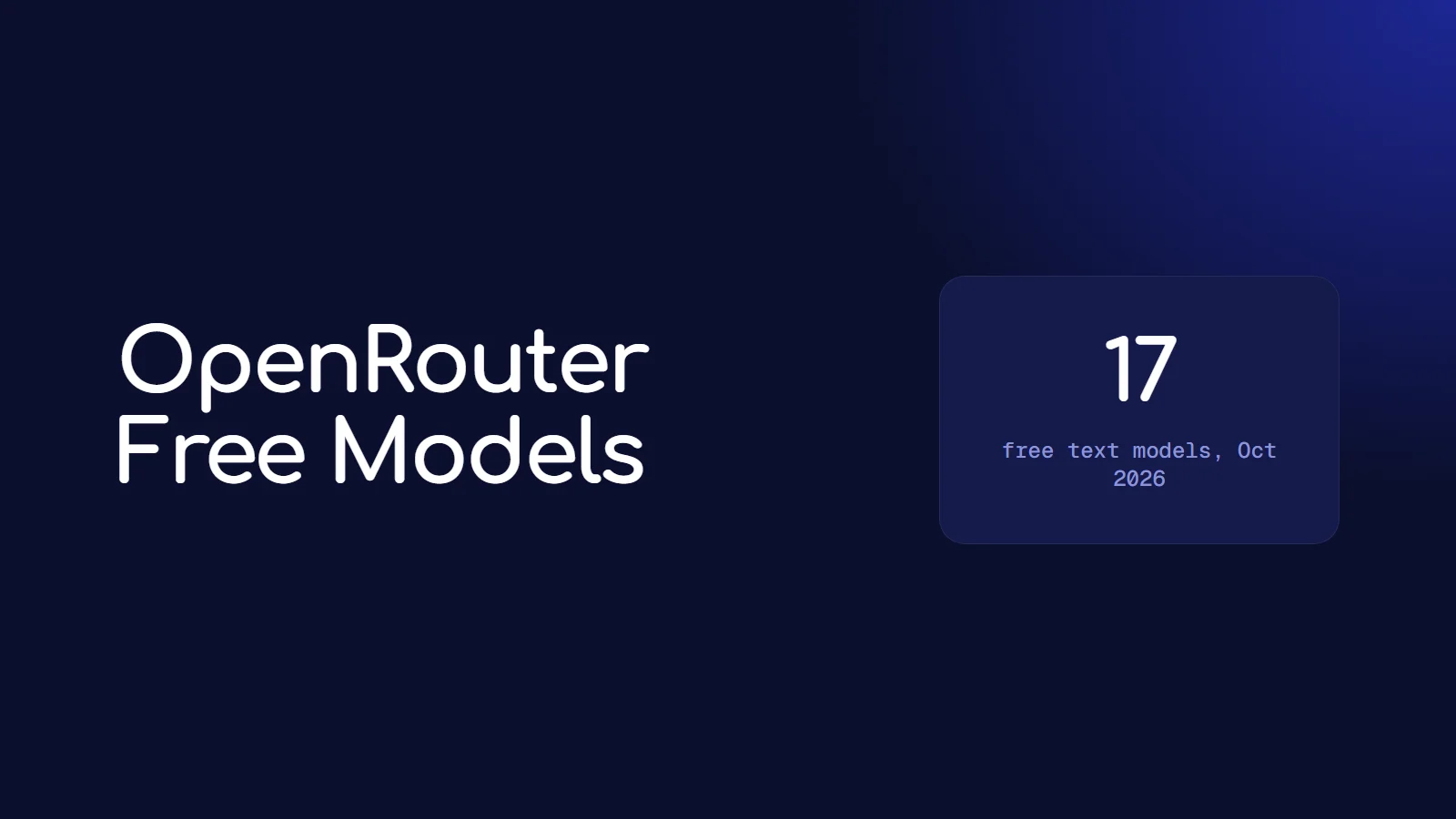
Yes, you can still get a free LLM API key in 2026, and most of them don't need a credit card. The best free LLM API for most people is Google AI Studio (free Gemini Flash models), then Groq (very fast open models) and OpenRouter (17 free text models behind one key). NVIDIA, Mistral, Cloudflare and Cohere also have free tiers with tighter rules.
What changed this year is the list of providers that are no longer free. GitHub Models shut down in July, Cerebras replaced its free tier with a $5 trial, and Hugging Face no longer gives free accounts any monthly credit. A lot of "free LLM API" lists still recommend all three.
I checked every number below against each provider's own docs on October 25, 2026. Where a provider doesn't publish its limits, I say so.
Which free LLM APIs still work in 2026?
| Provider | What's free | Free limits (official where published) | Card needed? | The catch |
|---|---|---|---|---|
| Google AI Studio | Gemini Flash, Flash-Lite, 2.5 Pro, Gemma 4 | Per project, shown live in AI Studio | No | Free-tier prompts are used to improve Google products |
| Groq | Open models like gpt-oss-120b and Qwen 3.8 | e.g. 30 requests/min, 1,000/day for gpt-oss-120b | No | Low tokens per minute (8K on big models) |
| OpenRouter | 17 text models tagged :free | 20 requests/min, 50/day (1,000/day after a $10 top-up) | No | 50 a day goes fast with coding agents |
| NVIDIA build | 100+ hosted open models | About 1,000 credits, about 40 requests/min (not officially published) | No | Meant for testing, no official way to raise limits |
| Mistral | Experiment plan, full model range | Not published any more, check your console | No, but phone verification | Your inputs can be used for training |
| Cloudflare Workers AI | Dozens of open models | 10,000 Neurons a day | No | Neurons are hard to translate into tokens |
| Cohere | Trial key for Command models | 20 chat requests/min, 1,000 calls a month | No | Evaluation use, not production |
The 7 free LLM API providers, one by one
1. Google AI Studio (Gemini API)
This is the most generous free tier for real apps. The Gemini API pricing page lists a free tier for Gemini 3.8 Flash, 3.6 Flash, the Flash-Lite models, Gemini 2.5 Pro, 2.5 Flash and Gemma 4. The newest Pro and image models are not on it.
- Limits: set per project, not per key, and they vary by model. Google sends you to your own AI Studio rate limit page for the live numbers. Daily quotas reset at midnight Pacific time.
- Get a key: sign in to AI Studio with a Google account and create an API key. No card.
- The catch: on the free tier, Google says your content is used to improve its products. Don't send private client data through it.
2. Groq
Groq runs open models on its own chips, and it is noticeably fast. It is the one I would pick for a chatbot or anything where response time matters.
- Limits: the Groq rate limits page lists, for example, 30 requests a minute, 1,000 a day and 8,000 tokens a minute for
openai/gpt-oss-120b. Smaller models get more requests per day. Limits apply to your whole organization, so extra keys don't add quota. - Get a key: console.groq.com, sign in with email, Google or GitHub.
- Base URL:
https://api.groq.com/openai/v1(OpenAI-compatible). - The catch: 8,000 tokens a minute is small. A long prompt plus a long answer can hit it in one request.
3. OpenRouter
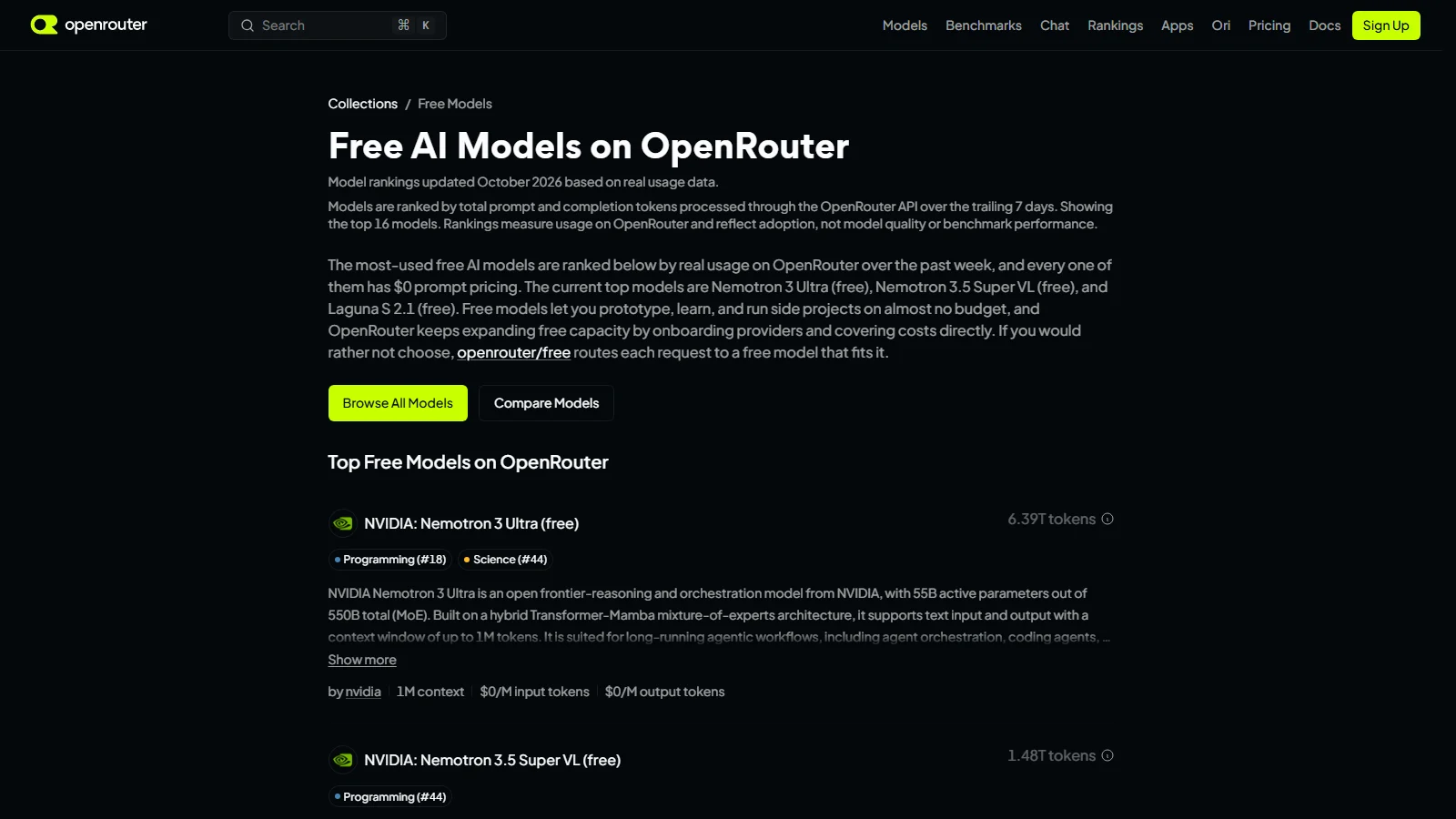
OpenRouter is one key for hundreds of models, and some of them cost nothing. When I pulled its public model list on October 25, 19 of 467 models were priced at $0, and 17 of those were text models with the :free tag. The strongest free text models were NVIDIA's Nemotron 3 Ultra and Nemotron 3 Super, Poolside's Laguna S 2.1, Google's Gemma 4 31B and Thinking Machines' Inkling.
- Limits: from the OpenRouter limits docs, free models allow 20 requests a minute. You get 50 requests a day until you have bought $10 of credits in total, then 1,000 a day.
- Base URL:
https://openrouter.ai/api/v1. Free model IDs end in:free. - The catch: the free list changes often, and each free model is served by whichever provider hosts it. Some of those providers log prompts. If you only buy one thing on this list, the $10 top-up is the best value, because it lifts the free models from 50 to 1,000 requests a day.
4. NVIDIA build (NIM)
NVIDIA's build.nvidia.com hosts a large catalog of open models (DeepSeek, Qwen, Kimi, GLM, MiniMax, Gemma and NVIDIA's own Nemotron) behind one OpenAI-compatible key that starts with nvapi-.
- Limits: NVIDIA doesn't publish them. Developers on its forums consistently report about 1,000 credits on signup and about 40 requests a minute, and forum moderators say there is no official way to get that raised on the free tier.
- Base URL:
https://integrate.api.nvidia.com/v1. - The catch: 40 requests a minute sounds like a lot until you run a coding agent, which can make several calls per second. It's built for trying models, not running products.
5. Mistral (Experiment plan)
Mistral's free Experiment plan gives API access to its models, including Codestral for code.
- Limits: Mistral no longer publishes exact numbers. Your live limits are in the Mistral admin console under Limits.
- Get a key: sign up and verify a phone number. One phone number per free plan.
- The catch: the free plan comes with consent to use your inputs for training. Treat it as a playground, not a home for real user data.
6. Cloudflare Workers AI
If you already deploy on Cloudflare, Workers AI is the easiest free model access to wire into an app. The Workers AI pricing page gives everyone 10,000 Neurons a day at no charge, on both the free and paid plans.
- What's a Neuron? Cloudflare's unit for GPU work. Different models burn Neurons at different rates, so there is no single "tokens per day" number.
- The catch: the models are smaller than what OpenRouter or NVIDIA offer, and context windows are often shorter.
7. Cohere (trial key)
Cohere gives every account a free trial key for its Command models, plus embeddings and rerank, which are useful for search and RAG projects.
- Limits: per the Cohere rate limits docs, trial keys allow 20 chat requests a minute and 1,000 API calls a month in total.
- The catch: trial keys are for evaluation. For production, Cohere wants a paid key.
Which "free" LLM APIs are no longer free?
These still show up in older lists and in some top-ranking articles, so this is the section that saves you an evening.
- GitHub Models: shut down. GitHub's docs say it was fully retired on July 30, 2026. The playground, catalog and API are gone for everyone.
- Cerebras: trial only. The Cerebras rate limits docs now say there is no permanently free tier. New accounts get $5 in credits that expire after 30 days.
- Hugging Face: no free monthly credit. The Inference Providers pricing page lists "None" for free users. You need to buy credits or pay $9 a month for PRO, which includes $2 of credit.
- Anthropic's $100 promo: ended. It closed on August 2, 2026.
Is there a free Claude API key?
No. Anthropic doesn't have a free tier for the Claude API. New Console accounts get a small one-time trial credit to test the API (Anthropic doesn't publish the amount), and that is it. Approved startups can apply to Claude for Startups for API credits.
Be careful with sites offering "free unlimited Claude API keys". They are either reselling access, sharing leaked keys, or not actually Claude. A leaked key can be revoked at any moment, and the owner pays for what you use.
If what you actually want is Claude Code without paying, that's a different problem with real answers. I covered the options that work in my guide to free unlimited Claude Code, and the official pricing in Claude Code pricing and free options.
How do you make your first free API call?
Almost every provider above speaks the OpenAI API format, so one request shape works everywhere. Here is Groq, with your key in an environment variable called GROQ_API_KEY:
curl https://api.groq.com/openai/v1/chat/completions \
  -H "Authorization: Bearer $GROQ_API_KEY" \
  -H "Content-Type: application/json" \
  -d '{"model": "openai/gpt-oss-120b", "messages": [{"role": "user", "content": "Say hi in five words"}]}'
The same thing in Python, pointed at OpenRouter's free Nemotron model:
from openai import OpenAI
import os

client = OpenAI(
    base_url="https://openrouter.ai/api/v1",
    api_key=os.environ["OPENROUTER_API_KEY"],
)

reply = client.chat.completions.create(
    model="nvidia/nemotron-3-super-120b-a12b:free",
    messages=[{"role": "user", "content": "Say hi in five words"}],
)
print(reply.choices[0].message.content)
To switch providers, change three things: the base URL, the key, and the model name. Nothing else.
Can you use a free API key with Claude Code?
Yes, through OpenRouter, because it offers an Anthropic-compatible endpoint. Its Claude Code guide uses these settings:
export OPENROUTER_API_KEY="your-openrouter-key"
export ANTHROPIC_BASE_URL="https://openrouter.ai/api"
export ANTHROPIC_AUTH_TOKEN="$OPENROUTER_API_KEY"
export ANTHROPIC_API_KEY=""
Then set ANTHROPIC_DEFAULT_SONNET_MODEL to a free model ID, run /logout if you were signed in to an Anthropic account, start claude, and check /status.
Two honest warnings. First, OpenRouter itself says Claude Code is only guaranteed to work with Anthropic's own models, so a free model may fumble tool calls. Second, Claude Code makes many requests per task, and 50 free requests a day can disappear in one session. If you go this way, the $10 top-up for 1,000 requests a day is what makes it usable.
Which free LLM API should you use?
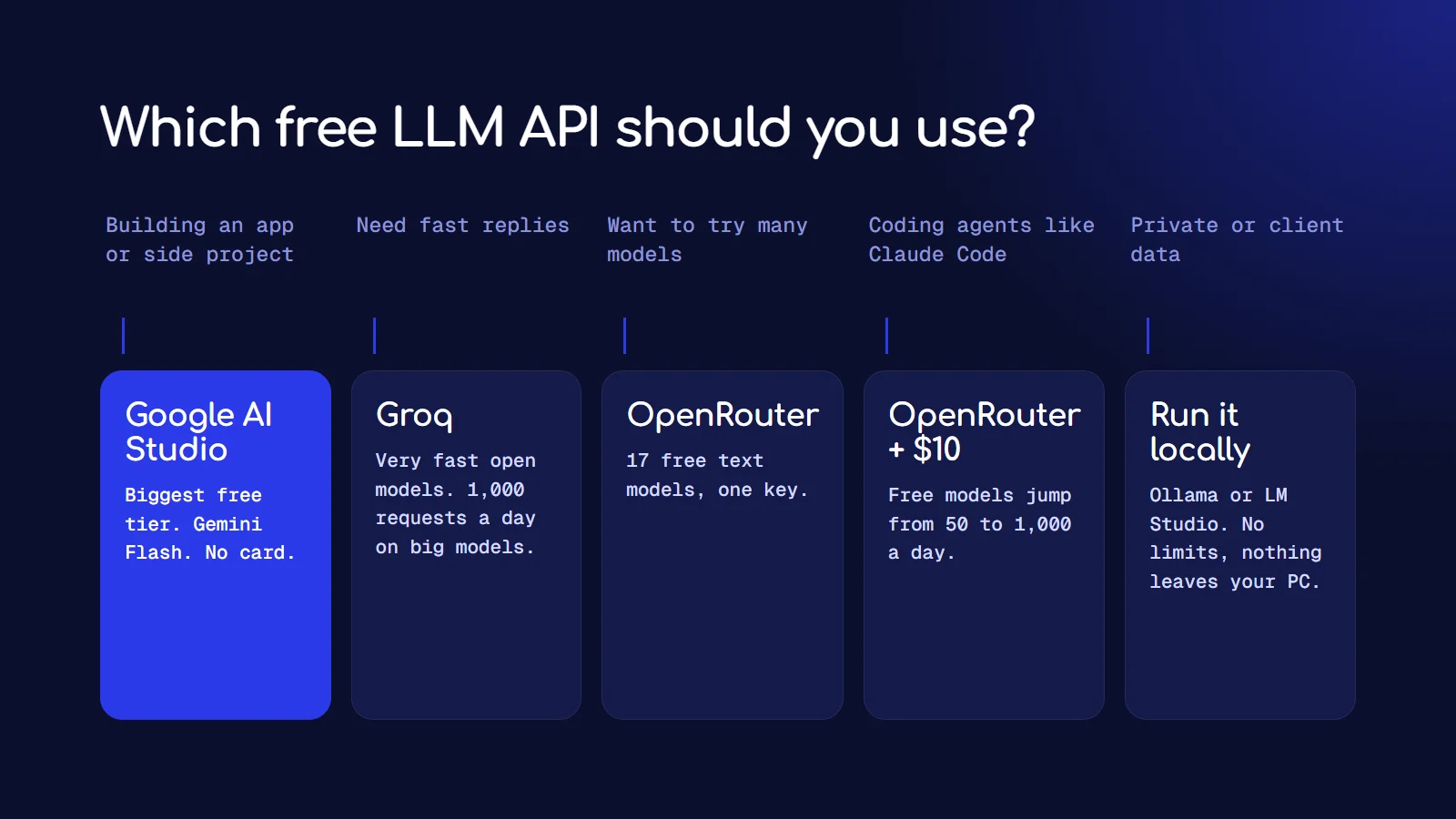
- Building an app or a side project: start with Google AI Studio. Big free tier, good models, no card.
- You need speed (chatbots, voice, live UI): Groq.
- You want to try lots of models with one key: OpenRouter.
- Coding agents like Claude Code, OpenCode or Cline: OpenRouter with the $10 top-up, or a local model.
- Private or client data: none of the free tiers. Pay for an API with a no-training policy, or run a model on your own machine with Ollama, which is free and has no limits except your hardware.
What are the catches with free LLM APIs?
- Your data may train their models. Google's free tier and Mistral's Experiment plan both say so. Read the terms before sending anything sensitive.
- Limits change without warning. Mistral stopped publishing its numbers, Cerebras dropped its free tier, Hugging Face removed free credits, all within a year.
- Free models get swapped out. OpenRouter's free list is different every few weeks. Don't hardcode one free model into anything important. Keep the model name in a setting you can change.
- Free tiers are for building, not production. Most providers say it directly. The moment real users depend on your app, a $5 or $10 paid tier is cheap insurance.
Frequently asked questions
Is there a completely free LLM API with no limits?
No hosted API is free with no limits. The closest thing is running an open model locally with Ollama or LM Studio. It costs nothing per request, and the only limit is your computer's speed and memory.
Which free LLM API doesn't need a credit card?
All seven in this guide: Google AI Studio, Groq, OpenRouter, NVIDIA, Mistral, Cloudflare Workers AI and Cohere. Mistral asks for phone verification instead.
What is the best free API key for AI coding?
For coding agents, OpenRouter is the most practical, because one key gives you several strong free coding models and it works with Claude Code. Buy the $10 top-up so you get 1,000 free-model requests a day instead of 50.
Can I use a free LLM API in production?
You can, but you shouldn't rely on it. Free limits are low, they change without notice, and some providers train on free-tier data. Use free tiers to build and test, then move to a paid tier for real users.
Do free LLM API keys expire?
The keys themselves usually don't, but some free offers do. Cerebras credits expire after 30 days, and Anthropic's trial credit is a one-time amount. Google, Groq, OpenRouter, Cloudflare and Cohere free tiers are ongoing, as of October 2026.